Hockey Inside Out Games, News and Opinions | Montreal Gazette









Latest Sports Videos

- Advertisement 2Stories continue below





Player grades: Edmonton Oilers roll to 5-1 win, force Game 7 in Vancouver
Canucks 1, Oilers 5 One game after Vancouver Canucks played their best game of the series, Edmonton Oilers did the same on their own home ice to live on for at least another day. Facing elimination, the Oilers played a strong defensive game in front of Stu Skinner and provided plenty of goal support along the way, solving Arturs Silovs 5 times on the night. The game was closer than the 5-1 final suggested, but make no mistake that Edmonton was the better club and deserved the result. The Oilers minded their defensive P’s and Q’s for the most part, limiting the visitors to just 15 shots on net compared to 27 the other way. Grade A shots recorded by the Cult of Hockey were a little closer, 11-9 for Edmonton, with Vancouver holding a 4-2 edge in 5-alarm shots. Grade A shots running count For a second straight game both teams failed to connect on the powerplay, with each unable to convert nearly a full minute with a 2-man advantage. Edmonton’s regulars on their PK unit all get a bump in their grade for this game. Player grades #2 Evan Bouchard, 8. Led the team with 22:25 TOI. Had a bit of a slow start, just a smidge off on his passes while mistiming a couple of one-timers. Came on strong as the game went along, earning a point in each period. Earned a pair of secondary assists on good outlet passes, and scored himself with a bomb from 59 feet that overpowered Silovs, then rang the post on its way to the net. Had another (correctly) disallowed due to contact with the goaltender. His boxcars of 1-2-3, +4 would have done Feist proud. Now up to 5-13-18, +10 through 11 playoff games. Contributions to Grade A Shots (GAS): Even Strength: +2/-1; Special Teams +1/-0. #5 Cody Ceci, 6. Second among defenders with 20:40 TOI. Rock solid defensively, both at even strength and on the powerplay, with Vancouver mustering just 3 shots in total during that period-plus. 3 shots, 3 hits, and a lot of won battles. GAS: ES +1/-0; ST 0. #10 Derek Ryan, 6. Kept things clean as the Canucks msutered just 1 shot and 0 Grade A’s during his 9 minutes at evens. Also chipped in on the PK, though he served a couple of nervous minutes in the box himself late in the second. GAS: ES +0/-0; ST 0. #13 Mattias Janmark, 6. As with Ryan, sawed off nearly 9 minutes at even strength, and provided 2:38 of fine penalty killing. Oilers were not generating shots on his watch, nonetheless the puck was spending plenty of time in good places far from Edmonton’s net. Continued his running feud with J.T. Miller, resulting in each player spending a couple minutes in the box. GAS: ES +0/-0; ST 0. #14 Mattias Ekholm, 6. Played just 15:24, least of any defender, including none at all in the game’s final 11 minutes. I watched his last shifts for signs of injury but all seemed normal other than he changed up a bit early (and not for the first time). With the Oilers holding a comfortable lead down the stretch and their 34-year-old d-man reportedly dealing with an illness there was no reason to keep running him out there. He did participate in the end-of-game celly. 0 shots, 2 hits, and an impressive +3. His biggest contribution was 5:02 on the first unit penalty kill including all 56 seconds of that 3v5. GAS: ES +2/-1; ST 0. #18 Zach Hyman, 7. Played 20:55, fired 4 shots on net. Most important was the delayed-release slot shot that he powered through Silovs to put Edmonton up 2-1 midway in the second, and which stood up as the game winner. His league-leding 10th of the playoffs. GAS: ES +4/-0; ST 0. #25 Darnell Nurse, 6. Played an active and effective game. 4 shots, 2 blocks, 3 hits. Among those beaten on the lone Vancouver goal. Put out a few fires and logged a team-high 29 shifts, though just 19:21 TOI. GAS: ES +1/-2; ST 0. #27 Brett Kulak, 6. Played 17:55, all but 6 seconds of it at even strength. Vancouver attempted quite a few shots during his time but only 4 of them got through to the netminder. Kept things simple on a largely effective pair with Ceci. GAS: ES +0/-1; ST 0. #28 Connor Brown, 6. The only Oiler below 10 minutes, though close at 9:47. Not much happened on his watch, none of it bad. GAS: +0/-0; ST 0. #29 Leon Draisaitl, 8. Took an early interference penalty for no good reason, but got his considerable game going thereafter. Fine head-man pass to Holloway for the first goal. Cleanly won faceoff on the fifth. In the process reached the 100-point milestone in just his 60th career playoff game, third fastest all-time behind only Wayne Gretzky and Mario Lemieux. Had several shooting opportunities but couldn’t find the range. Excellent defensively: Oilers dominated the shot clock 11-1 during his 13 minutes at 5v5. GAS: ES +4/-0; ST 0. #37 Warren Foegele, 6. Sawed off at even strength, giving up practically nothing. Like many Oilers, gets a bonus grade for his fine work on the PK. GAS: ES +2/-0; ST 0. #39 Sam Carrick, 5. Drew into the line-up in place of Corey Perry and delivered 10½ uncompromising minutes, delivering 6 hits in the process. Drew a penalty with a hard forecheck. A team best 7/12=58% on the faceoff dot. GAS: ES +0/-2; ST 0. #55 Dylan Holloway, 8. Electrified Rogers Place with a brilliant goal to open the scoring. Powered through Vancouver’s defence, sequentially beating Elias Pettersson, Quinn Hughes, Filip Hronek and Silovs before powering the puck home from close range. Was part of the big screen that blined Silovs on the 5-1. Oilers owned a 12-2 shot advantage during his 12 minutes at 5v5. 3 shots off his own stick, 2 more blocks at the other end which is emerging as something of a specialty. GAS: ES +2/-0; ST 0. #71 Ryan McLeod, 5. Played a few ticks under 15 minutes. Mostly effective, though he did get turned inside out by Pettersson in the build-up to Vancouver’s lone goal. 1 shot, 3 hits, solid on the kill. GAS: ES +2/-2; ST 0. #73 Vincent Desharnais, 6. Led the Oilers with 5 hits and also with 5:21 on the penalty kill, where he was outstanding. He too was unable to contain Nils Hoglander’s 2 shots that produced the lone Vancouver goal. GAS: ES +0/-3; ST 0. #74 Stu Skinner, 8. Got the crease back after a 2-game rest with zero room for error, and responded with an excellent performance. Didn’t face a lot of shots but quite a few dangerous ones. The best of his saves was a blocker stop of a seeing-eye wrister by Hughes during Vancouver’s 5-on-3 in the last minute of the second frame. Game changer. Saved 1.8 goals above expected. 15 shots, 14 saves, .933 save percentage. #91 Evander Kane, 8. All over it with 8 shot attempts, 4 on net, including a wicked drive through a multi-player screen to close out the scoring. Made a fine stretch pass to Draisaitl for an excellent chance. 7 hits to lead the Oilers. Went where angels fear to tread all night long, including a few more one-on-one battles with the gigantic Nikita Zadorov. GAS: ES +2/-0; ST 0. #93 Ryan Nugent-Hopkins, 9. Touched the game in all areas, playing 21:04 to lead the forwards. Set up both second-period goals, then scored the 4-1 himself by going hard to the net and outworking big Carson Soucy to tap home McDavid’s pass. Outstanding on the penalty kill (3:34), including the entirety of that crucial 56-second 3v5. GAS: ES +3/-2; ST 0. #97 Connor McDavid, 8. Bounced back from a subpar game in Vancouver, delivering primary assists on the second, third and fourth goals that basically put this one away. 2 shots, 2 hits, 2 takeaways. His one bad moment was a careless high-sticking penalty in the opening frame. His contact with Silovs negated an apparent Oilers goal, but it would never have gone in had not McD been marauding in the blue paint in the first place. GAS: ES +5/-1; ST 0. Recently at the Cult of Hockey McCURDY: Skinner gets the net back for Game 6 STAPLES: Changes in the works for Game 6 STAPLES: Secret sauce from each Oilers player to avoid Game 6 elimination McCURDY: Ekholm, Draisaitl, Kane — Maintenance Men by day, difference makers by night LEAVINS: 9 Things Player grades LEAVINS: Game 5 — Canucks 3, Oilers 2 STAPLES: Game 4 — Oilers 3, Canucks 2 McCURDY: Game 3 — Canucks 4, Oilers 3 STAPLES: Game 2 — Oilers 4, Canucks 3 (OT) LEAVINS: Game 1 — Canucks 5, Oilers 4 Follow me on X-Twitter @BruceMcCurdy
- Advertisement 3Stories continue below
Edmonton Oilers put boots to Vancouver Canucks to force Game 7
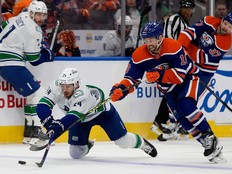
You didn’t think the Edmonton Oilers were going to go away that easily, did you? With their backs to the abyss and their playoff lives flashing before their eyes, the Oilers delivered a resounding show of force Saturday, reminding the Vancouver Canucks, and anyone else who doubted them, that they are a long way from dead. After struggling for offence the last three games, Edmonton broke out hard in Game 6, with Connor McDavid, Ryan Nugent-Hopkins and Evan Bouchard counting for three points each in a season-saving 5-1 triumph. “I thought the boys were ready from the start,” said winger Dylan Holloway, who opened the scoring on one of the nicest goals of the series. “We obviously knew what was at stake tonight. There were probably a bit of nerves, but once we kind of got settled in we played our game and rolled all four lines and never looked back. “We felt we were the better team for most of the series, we just couldn’t capitalize on our chances.” This time they did. After five one-goal games, this one was a rout. “I thought we did a good job of getting in on the forecheck and holding on to pucks and playing in their zone, making them defend and making it hard for them to work up the ice,” said McDavid. “I thought we played faster, we played cleaner, we were better with the puck, better coming through the neutral zone. We did a great job of getting on top of them on the forecheck and keeping pucks alive.” So a series the Canucks had in their grasp after a dominating performance in Game 5 put them up 3-2 with a chance to close things out in Edmonton will now come down a 60-minute war of wills against an opponent that just showed what it’s capable of when it comes face-to-face with the executioner. Game 7 goes Monday in Vancouver. “It’s nothing to be satisfied or excited about,” McDavid said of the Game 6 effort. “We just bought ourselves another day. I would expect the same level of urgency and desperation from our group and I would expect Vancouver to play a better game as well. “I expect a highly competitive, great Game 7.” Saturday night at Rogers Place was the Oilers at their best. They stayed tight defensively, were hard on the puck, outshot the Canucks 21-10 by the time the contest was out of reach and finally got to Vancouver goalie Arturs Silovs, striking a big psychological blow heading into Game 7. “We capitalized, that’s the key,” said Hyman, who scored his playoff-leading 10th goal. “We’ve had looks all series but we beared down on our chances and made good on them. Y ou have to get guys to the dirty areas and the blue paint and make it uncomfortable. “And t he more looks you get, just by nature you’re going to score more and I think we did a good job of producing more looks tonight and then capitalizing.” The first-period storm of desperation one might have expected from an Oilers team facing elimination never really came — Holloway scored on a great individual rush at 8:18 and the Canucks tied it when Nils Hoglander replied at 10:03. A 1-1 tie after 20 wasn’t a very good sign for a team fighting for its life on home ice. But the storm did come. Edmonton came to life in the second period, outshooting Vancouver 14-5 and opening up a 3-1 lead on goals from Hyman and Bouchard. “We’ve got off to some good stretches and then let them back into it in the series,” said Holloway. “Tonight we played a full 60. We got off to a hot start and got some goals and even when they came back to make it 1-1, we didn’t waver at all. We kept to our game.” An early marker from Nugent-Hopkins and one from Evander Kane closed the deal and forced a deciding Game 7. After Saturday night, the Oilers like their chances. “I thought we responded pretty well tonight,” said defenceman Vincent Desharnais. “This group has been through lots of adversity throughout the season. Even though we have a lot of skill but we have hard workers and if we can match their compete level in Game 7 it will be a good one for us.” NET RESULTS With Edmonton’s life on the line in Game 6, head coach Kris Knobauch made the bold, if not curious, pre-game decision to start Stuart Skinner in goal ahead of Calvin Pickard. So starting somebody who they hope had found his game over somebody who’s been excellent is a call that could have easily backfired, but Skinner is the guy they’ve invested their future in and he has shown an ability to rebound after a bad stretch, so they decided to live or die with their No.1 goalie. And he didn’t let them down. Skinner didn’t face a lot of shots but made all the saves he needed to. “ Every save he made he made it look pretty easy,” said Desharnais. “He didn’t have that many shots, but there were some Grade A’s and some screened shots. I’m not surprised the way he played tonight. He proved tonight that we can trust him.” SPECIAL TIMES The Oilers got some clutch penalty killing in the first period after Draisaitl and McDavid took minors and also closed out an extended five-on-three power play late in the second and early in the third to preserve a two-goal lead. “I thought our penalty kill was outstanding again, keeping momentum on our side,” said Hyman. “If they score a goal there, things are a little different obviously. It’s 3-1 and we get a huge 5-on-3 kill to start the third and we go out and score the next one and that’s the dagger obviously.” E-mail: rtychkowski@postmedia.com
"He was ripe for the picking": Social media reacts to big win for Edmonton Oilers goalie Stuart Skinner
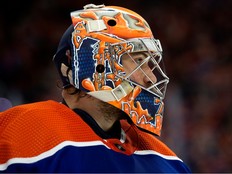
It ended with Connor McDavid praising him and with Sportsnet’s Kevn Bieksa, a Vancouver Canuck alumni, still doubting him. But all that mattered for Edmonton Oiler goalie Stuart Skinner was he got the win. In the biggest game of the season, the Edmonton Oilers went with Skinner in net over Calvin Pickard. It was an interesting and controversial decision, causing the usual storm of commentary on social media and in the mainstream media. Here’s how it’s played out on social media, starting with Oilers insider Bob Stauffer on Oilers Now on Friday, strongly hinting that Pickard would be replaced in net by Skinner. Bob Stauffer, Oilers Now I think hypothetically there’s a strong possibility we might see Stuart Skinner start tomorrow. Sportsnet commentator Elliotte Friedman (later that evening) Rest up, everyone. Big one tomorrow night. Game 6 Canucks/Oilers. I’m thinking Stuart Skinner for Edmonton Game Day morning Daily Face-off commentator Frank Seravalli @frank_seravalli We’ll see what develops this morning, but the belief is these are the changes for #Oilers:Stuart Skinner starts Game 6. Sporstnet Vancouver commentator Brook Ward @brookwardsports Skinner: 12GA on 58 shots .793% in series… .877% in 8 playoff games this season. The Cult of Hockey’s David Staples @dstaples If today’s game was an election campaign, I would rally around the “Stick with Pick” side. But not an election. Just one guy has a vote. Here is hoping Coach Knoblauch nailed it. And good luck to Skinner. He has had big games before. Bring it! Sportsnet Vancouver commenator Mike Halford @MikeHalford604 “stu has been our guy all year,” knoblauch said. “assuming you don’t count our last seven periods of competitive hockey.” Oilers fan St.Albert James @RealCNN I love Carrick in for Perry but Skinner in this year’s playoffs is absolute madness. I’d be playing Campbell over Skinner at this point. Oilers fan Arpeggi @TheWeirdestFish If Skinner lets in a single soft goal, it’s all over. I don’t have the confidence he’d be able to weather that in his fragile state. Game day at practice Edmonton Oilers @EdmontonOilers “I’m very excited to get back in the net.” Skinner speaks ahead of starting in tonight’s Game 6. The Cult of Hockey’s Bruce McCurdy Skinner has had his struggles in the postseason for the second year in a row, especially in the current Vancouver series. He played the first 8 periods, allowing 12 goals on just 58 shots for a miserable .793 save percentage. Backup Calvin Pickard mopped up in Game 3, then played the entirety of Games 4 and 5 as the two teams split a pair of 3-2 decisions. Oilers fan Matt Henderson Arch @Archaeologuy Nothing scares me more than going back to Skinner. Oilers fan Sumit Tripathi @Sumit_Tripathi_ Skinner absolutely the right choice. We live or die by Skinner Oilers fan Lauren 🩲 @lllaurenA Skinner needs to bring Roloson energy tonight. Cause if he brings Conklin energy, might as well book that tee time now. CHED commentator Shaye Ganam @ShayeGanam Careers aren’t often made or lost in a single game. But a single game can definitely be a defining moment in a career. Good and bad. Here’s hoping local kid Stuart Skinner is lights out tonight. Pressure makes diamonds. Oilers fan Captain Jack 🏴☠️ @OilersJack Unpopular Opinion: Starting Starting Stuart Skinner Tonight is so f*cking ballsy that I actually like it. Oilers fan Tyson Munro @Tys35 Stating my opinion now so I can’t use revisionist history after the fact: I believe going back to Skinner is the right choice. I’m fully prepared to be wrong 🤷🏻♂️ Pre-game Sportsnet Elliotte Friedman Back in Game 3, Skinner gave up four goals in 15 shots…One of the things I think was a big deal was Skinner’s reaction after goals. He sagged noticeably… One of the things that Oilers have worked with Skinner on is not looking so defeated after he’s scored on. But he regressed that night. It’s not 1A and 1B for me. He’s your starter and Pickard is way below. Sportsnet Kevin Bieksa It’s definitely the right decision to put him back in… I still think you should have went back to him in Game 5. He is your #1. He’s your ride or die. Sportsnet Luke Gazdic This is an opportunity for Stu to kind of right the narrative about his playoff success and kind of silence the critics a little bit. But I love this decision. He’s your guy and you go with him. Oilers coach Kris Knoblauch A tough decision with the way Picks had played obviously but looking on our season on the line and seeing what Stu has done for us this season. Since I’ve been here he’s looked like an elite goaltender with Vezina-like numbers. And right now we need a big game from him and we’re going with him. Sportsnet Kelly Hrudey I struggled with this a tiny bit. I was thinking Pickard probably deserves a chance but my gut was always telling me that it’s going to be this guy, Skinner. He deserves it. He’s their #1 guy. For Skinner, I hope that he feels like he doesn’t have to be perfect. I think that having. a clean first period is very important. First period Hoglander goal, Oilers 1, Canucks 1 Dustin Nielson @nielsonTSN1260 How does Hoglander get that open for TWO cracks at it. Oilers fan Dr. van Nostrand @DrvanNostrand39 It’s absolutely too much to ask for a big save from Skinner. Oilers fan Karman Gill @Kgill39 McLeod and Nurse left a nobody player wide open. Do these guys even want to win? Oilers fan Jason Buzzell @buzzilinear Three standing there in the slot. Canucks sticks in there and bury him. It’s the series difference every year. Grades A shots first period, 4: Garland, 1525, side of net (save); Hoglander, 958 (save); Hoglander, 957 (goal); Lindholm, 210 (save). Sportsnet’s Kelly Hrudey They (Vancouver) let him (Skinner) off the hook. The big question going into it, is he going to be nervous? And it was answered in the first period. He had a bunch of moments. It was OK early on but he didn’t have any dangerous shots, only four shots he faced in the entire period. So I thought Vancouver, they should have been bombarding him. It’s not like he’s brimming with confidence right now. And it was just way too easy of a period for Skinner. Second Period Canucks Army blogger Wyatt Arndt @TheStanchion Greasy game or not, Skinner does not look comfortable in net and the Canucks are not testing him at all right now. Second period tilting the ice for Edmonton right now, Vancouver staring at some headlights and not moving Canucks Army blogger Vancouver Wyatt Arndt Canucks power play is actively losing them this game. Lack of urgency is incredible. Cannot stress enough that Stuart Skinner is who you are shooting on. Just put the puck on net. Sportsnet’s Elliotte Friedman That Skinner blocker on Hughes was massive for him and for the team Oilers fan Stan Gilbert @Snideguy Was he using the force on that save?! Vancouver Sun hockey writer Ben Kuzma @benkuzma Skinner with PK blocker deny on Hughes. Period ends. Van outshot 14-5 in second frame. #Canucks TNT commentator Paul Bissonnette@BizNasty2point0 Incredible stop by Skinner with the blocker. That’s the big one he needed. Let’s see if the Oilers can keep locking it down the last 20. Monday night in Vancouver would be electric. Sportsnet commentator Craig Simpson They (Canucks) have really let Skinner off the hook early on, haven’t really tested him and forced him to be great. Grades A shots second period, 1: Hughes, 39. Third period Oilers fan Oilers Ent @oilers_ent Coach Knob was right to put in Skinner. I was wrong to question it. The team played better in front of him tonight. It was a good show. Game Seven here we come. 👍🏼 Oilers fan Tyson Munro Skinner did exactly what was needed of him tonight. Great win. Edmonton Oilers captain Connor McDavid We were solid in front of Stu. Not many shots but the ones they did get I thought were dangerous. He did a great job stepping up… We never had a doubt. Honestly, he’s a battler and he’s always been a battler.” Sportsnet’s Bieksa What did Skinner have, like seven shots on net after two (periods)? And Kelly Hrudey said, ‘It’s not like he was beaming with confidence.’ The Canucks just let him off the hook by playing a very simple passive game… They had very few shifts where they were in the Edmonton zone and peppering Skinner. And he was ripe for the picking. Grades A shots second period, 1: Suter, 853 (save), Pettersson, 751 (post), Cole, 628 (save), Hronek, 459 (save) At the Cult of Hockey we had the Grade A shots 12 for nine for Edmonton, with the subset of more dangerous 5-alarm shots Edmonton two, Vancouver four. At the Natural Stat Trick, expected goals ere 2.8 for Vancouver, 2.7 for Edmonton. My own bottom lines? Skinner’s task wasn’t to shut down his doubters. It was to shut down his own doubts. With that monster save on Quinn Hughes — a game-changing moment — mission accomplished, I suspect. As for Bieksa’s comment, that’s excellent bulletin board material for Skinner. A huge win for Edmonton, for the Oilers, for Skinner, and one that should set up Skinner to be all the more ready for Game 7.

- Advertisement 4Stories continue below


NHL notes: Paul Maurice and Florida Panthers head to Big Apple for Round 3 of NHL playoffs
Wayne Gretzky was still active for the Rangers the last time New York met the Florida Panthers in a playoff series. That was about the only memorable part for the Cats who lost that 1997 duel to the Rangers in five games. Florida coach Paul Maurice was trying to study as much as he could about his Eastern Conference final opponent the morning after dispatching the Boston Bruins, with a few days to prep for Game 1 Wednesday in Manhattan. The experience factor is the Cats’ corner with a trip to the Stanley Cup final last year and now two rounds through this spring. But the Rangers finished first overall, splitting two late-season games against the Panthers. “You’ve watched (New York beating Washington and Carolina) in between our games and see they’re very fast, very talented team, very dynamic off of the rush,” Maurice said Saturday. “They’ve got all the (key) spots, the goaltending, four at the back end very strong and the forwards are very skilled. We have to go a little longer, maybe more detailed on the video.” Maurice’s team is halfway back to another shot at the Cup. He credited his leadership group for not bringing any negativity into training camp. “They came back more determined, or they felt they were closer and had that belief when they came back. They haven’t been tired. We had three really important pieces of our lineup (forward Sam Bennett and defencemen Aaron Ekblad and Brandon Montour) out at the start, so we had to play well defensively. We battled hard and got some consistency,” One coaching quirk involving Maurice and New York’s Peter Laviolette, they both coached the Carolina Hurricanes and replaced each other in the early 2000s. Laviolette won the Cup in 2006 with the Canes in place of Maurice after Maurice, who git as far as the ’02 final, then Maurice in a second stint, bumped Laviolette. SELKE LOVE FOR SASHA It would have been quite the feat for Toronto’s Auston Matthews to lead the NHL with 69 goals and be named its best defensive forward as winner of the Frank Selke Trophy. Voters from the Professional Hockey Writers Association thought enough of Matthews’ shot blocking, takeaways and faceoff prowess to make him a finalist, but gave the award to Aleksander Barkov of the Panthers in a Saturday night announcement. Carolinas Barkov, a three-time nominee and first Panther to get the honour, assisted Florida in tying for first in the league in goals-against per game (2.41), the lowest mark in club history. He took a team-leading 1,100 draws with a winning percentage of 57.3%, ninth among players to play at least 50 games and take at least 500 face-offs. Carolina’s Jordan Staal was the other finalist. CHIEF AND THE CAPTAIN Maple Leafs captain John Tavares will now have to get used to his third coach in six years in Toronto with Carig Berube’s appointment. “Obviously very difficult so see (Sheldon Keefe) go,” Tavares told reporters Saturday in Prague where he’s wearing the ‘C’ for Canada at the world championships. “As players, it’s on us to do a better job. With Craig coming in he’s going to help us with that. I’m excited to work with him. He’s got a tremendous pedigree.” More information about who Berube might have as his Toronto assistants could come out Tuesday when he’s officially introduced. One member of his St. Louis staff from the 2019 Stanley Cup year, Mike van Ryn, is already working in Toronto. Steve Ott, his other primary assistant on the Blues, stayed put and is now with Team Canada as an assistant. Guy Boucher, Dean Chynoweth and Manny Malhotra are the other assistants who worked with Keefe. TEAM USA LIKES MIKE Canada and the other hockey powers now know which coach of a well-known foe they’ll face at the Four Nations Face-off next year and in the 2026 Olympics in Italy. USA Hockey announced Saturday that Mike Sullivan, two-time champion behind the bench of the Pittsburgh Penguins, will get the gig. Sullivan’s two Cups in 2016 and ’17 are part of an 11–year record of 445-275-115 and he was an assistant for the Americans in the 2016 World Cup of Hockey. Canada has named its management staff for the Four Nations, to be played in February in Canada and the U.S. with Finland and Sweden as a replacement for the all-star game, but not its coach. Berube will quickly command the respect factor needed to lift Leafs Craig Berube's past Stanley Cup success won't necessarily result in championship for Maple Leafs lhornby@postmedia.com X: @sunhornby
- Advertisement 5Stories continue below


- Advertisement 6Stories continue below